
A guide to the places in this city that have no interest in being sensible. From a fairytale café perched above the Thames to a shop that sells bottled fear to monsters, these are London’s most gloriously, stubbornly unusual spots.
London does many things well. It does civic grandeur, it does grime, it does world-class museums and streets so ordinary they could be anywhere. What it does less obviously, but with equal commitment, is whimsy. Tucked behind Highgate bus stops and down Hackney side streets and up Richmond hills, there is a city running parallel to the ordinary one, filled with people who decided that a tropical rainforest inside a concrete arts centre was a reasonable thing to create, or that a shop for monsters was the correct use of a Victorian shopfront, or that what a crumbling Edwardian pergola really needed was a bit of wisteria and several hundred devoted supporters. This is a guide to that city.
There is a London running parallel to the ordinary one, filled with people who decided that useful was not enough and beautiful was not enough and that what a thing needed, above all, was to be wonderful.
Hollyhock Vegetarian Fairtrade Café
Terrace Gardens, Petersham Road, Richmond · TW10 6UX
Perched on a hill in Richmond’s Terrace Gardens with views down through the trees to the Thames, Hollyhock is the café that people mean when they say a place feels like a fairytale. The veranda is held up by tree trunks. Inside there are mismatched chairs, copper kettles, decorative birdcages and strings of fairy lights. Squirrels investigate the outdoor tables with the confidence of regulars. In winter, blankets and hot water bottles are handed out with the food, and customers are encouraged to settle beside the wood-burning stove. When spring arrives the doors open onto a terrace that overlooks the river bend, with some of the finest views in the greater London area.
The food is vegetarian and vegan throughout, made from fairtrade and locally sourced ingredients. Pies, quiches, salads, homemade cakes, herb teas and a second-hand bookshelf by the entrance that has been there for years. The whole place operates at a pace that feels deliberately removed from the city it technically belongs to. It can be reached either from Richmond Hill at the top or through an arch underpass from the riverside at the bottom. Go on a weekday morning when the schools are in and the terrace is yours.
OmVed Gardens
1 Townsend Yard, Highgate · N6 5JF
Behind a yard off Southwood Lane in Highgate, tucked against the hill above the village, there is a three-acre garden that the founders describe as an attempt to listen to the sound of the universe. The name comes from Om, the sacred sound, and Ved, meaning knowledge. This explains the wildflower meadow, the willow circle, the vegetable plots, the ponds, the orchard and the seed library. It also explains the supper clubs held in a candlelit greenhouse, the fermentation workshops, the zero-waste cooking sessions and the yoga held in a circular timber building with a roof garden on top.
OmVed relaunched in 2025 after a two-year transformation, with a cluster of cedar-clad, pyramid-roofed structures designed by architect Piers Smerin built into the hillside, and a landscape by Paul Gazerwitz weaving woodland, meadow, vegetable plots and ponds into what the designers call a green village. The gardens are open to the public on Saturdays and Sundays, with a café that needs no reservation. The seed library holds rare and heritage varieties and runs a saving network that anyone can join. It is one of the few places in London that is genuinely difficult to categorise, which is the surest sign that it is doing something right.
Queen’s Wood Café
42 Muswell Hill Road, Highgate · N10 3JP
Originally built in 1898 as a wood keeper’s lodge for the ancient woodland of Queen’s Wood in Highgate, the building fell into complete dereliction over the following century. In 1998 a group of local people rescued it and turned it into a community café and garden. The woodland around it, one of four ancient woodlands in the London Borough of Haringey and thought to be a direct descendant of the wildwood that covered Britain five thousand years ago, is home to three species of woodpecker, rare plants and several types of bat.
The café itself is a timber cabin with a covered veranda open on three sides to the trees. You sit among the woodland while your coffee is being made. The menu uses produce from the community garden. There are poetry events, live music, forest bathing sessions and a woodland therapy cabin run by a community practice. It is walk-in only, which means weekend mornings get busy, but there is something appropriate about a place in an ancient wood that does not take reservations. Come on a weekday in autumn when the oaks are turning and the paths through the wood are quiet and yours.
Choosing Keeping
21 Tower Street, Covent Garden · WC2H 9NS
Choosing Keeping started in 2012 on Columbia Road in east London and relocated to Tower Street near Covent Garden, where it has been quietly captivating stationery devotees ever since. The founding philosophy is that pens, notebooks and writing implements should be assessed for their historical and cultural significance as well as their design and functionality. This is a serious position. It results in a shop that stocks Japanese pencils in their original factory packaging, Italian paper in colours that have no English names, rotary sharpeners of professional German manufacture and rulers shaped like nothing you have seen before.
The Christmas decoration selection, brought out each year, includes hand-blown glass bats, anthropomorphic toadstools, blackbirds and things that resist description entirely. It has been noted more than once that it is entirely possible to spend forty-five pounds on a stapler here and feel, walking out into Tower Street, that this was among the better decisions of your adult life. The shop’s Instagram account has over 145,000 followers, because people cannot stop looking at photographs of things inside it. Seeing them in person is considerably better. Open Monday to Saturday ten until half past six, Sunday eleven thirty until half past five.
Dalston Eastern Curve Garden
13 Dalston Lane, Dalston · E8 3DF
Where the old Eastern Curve railway line once curved out of Dalston Junction station and headed east toward the goods yard, there is now a free-to-enter community garden that celebrated its fifteenth anniversary in 2025. The entrance sits beside the Hackney Peace Carnival Mural at the busiest, loudest junction in Dalston, where Balls Pond Road meets Dalston Lane and Kingsland High Street. Step through the painted wooden gate and the noise of the junction drops away. There are birch, hazel and hawthorn trees. There are raised beds of tomatoes, peppers and herbs grown by volunteers. There are tables, blankets for chilly evenings, a wooden pavilion built by the architectural collective Exyzt, and a stage designed by Morag Myerscough that hosts live music on Tuesday evenings through the summer.
The garden runs as a social enterprise and funds its entire operation through the café, which sells coffee, homemade cakes, daily soup made from garden produce, and wine and beers from east London producers. Every pint of East London lager you drink here is paying for the garden to stay open, free, for one of the most densely populated and least-gardened corners of the capital. It is open every day of the year from around midday. Come in October for the pumpkin lantern festival, when a thousand candlelit gourds transform the whole place into something from a particularly good dream.
Hoxton Street Monster Supplies
159 Hoxton Street, Hoxton · N1 6PJ
Established in 1818, according to its own account of events, Hoxton Street Monster Supplies is London’s only purveyor of quality goods for monsters of every kind. The shelves hold tinned fear in a range of intensities, Brain Jam, Fang Floss, werewolf biscuits, dragon treats, zombie-fresh mints and an invisible cat named Wells who may or may not be present at any given moment. Signs on the windows request that patrons refrain from devouring the employees and ask that only one giant enter at a time. A death certificate is available for purchase at the counter should anything go wrong during your visit.
The shop is also a front, through a door at the back, for the Ministry of Stories: a creative writing and mentoring charity for children and young people aged eight and up, which runs free workshops in the space behind the stockroom. All profits from the shop go directly to the charity. Colin Firth, who is listed as Minister for Fluency, has described it as a place where buying a tin of fear means supporting the imagination of the next generation. Time Out named it the number one kids’ shop in London, which the shop finds understandably strange given that it is evidently a shop for monsters. Open Tuesday to Friday from one until five, Saturday eleven until five.
The Hill Garden and Pergola
Inverforth Close, Hampstead Heath · NW3 7EX
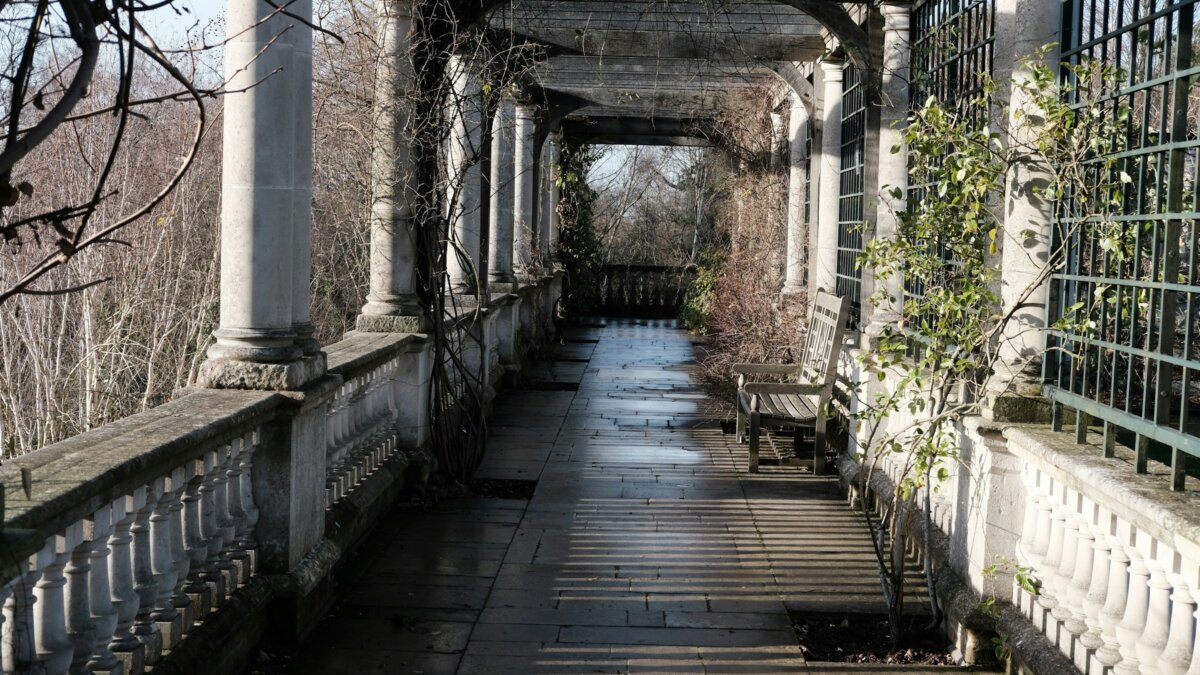
In 1906 Lord Leverhulme commissioned landscape architect Thomas Mawson to build a raised walkway and garden on the edge of his Hampstead estate as a setting for garden parties. The pergola that resulted stretches for 170 metres along the hillside, its Portland stone columns and wooden trellising now so thoroughly colonised by wisteria, roses and climbing vines that the original structure is visible only in glimpses. The house it belonged to was demolished long ago. The garden became public in 1963. It gives the impression, and the pleasure, of having stumbled into something very beautiful that was not quite meant for you.
In spring the wisteria blooms purple across the entire length of the walkway and the effect is the sort of thing that makes people stop walking and just stand there. In summer roses replace the wisteria. In autumn the whole structure turns gold. In winter the bare stone and timber have their own austere charm. A small lily pond sits at the centre of the Hill Garden below, overlooked by benches that are almost always occupied by people who appear to have no intention of leaving soon. The entrance is tucked behind a gate near Jack Straw’s Castle on the northern edge of Hampstead Heath. It is free, open daily from half past eight until dusk, and almost nobody who visits it does so only once.
The Barbican Conservatory
Barbican Centre, Silk Street, City of London · EC2Y 8DS
When the Barbican Theatre was built in the 1970s, the architects faced a practical problem: the fly tower above the stage, through which scenery is lowered down to the stage six storeys below, was a vast and ungainly structure that needed to be housed inside the building. Someone decided to put plants around it. Between 1980 and 1981, 1,600 cubic metres of hand-mixed soil was installed around the fly tower and planted with over 1,500 species of tropical trees and plants. Koi carp, ghost carp and grass carp from Japan and America went into the ponds. A colony of terrapins, relocated from Hampstead Heath where they had been terrorising the wildlife, went into a smaller pool by the arid house.
The result is London’s second largest conservatory, hidden inside one of its most forbidding pieces of Brutalist architecture. The contrast between the raw concrete exterior and the warm, humid interior full of date palms, tree ferns, Swiss cheese plants and coffee plants is so extreme that visitors routinely describe feeling they have stepped into a completely different world. Free timed tickets are released one month in advance on the Barbican website and sell out consistently, which tells you everything you need to know. Limited tickets are also released each morning at half past nine for that day’s session. Check the website for current opening days as the schedule varies.