
These are the locations that filmmakers keep returning to because they genuinely cannot be faked or replicated anywhere else. The stories behind each one are often as interesting as the films themselves.
London has been filmed almost continuously since cinema was invented. It stands in for Paris, it stands in for New York, it stands in for revolutionary France and alien invaded Earth and the Regency era and the end of the world. More than three hundred films and television series have used just one building in Greenwich as a location. The city is, in a very real sense, a standing set that has never been struck.
What follows is not a list of every place you might recognise from a film. It is a selection of locations chosen because each one has something genuinely interesting to say about why filmmakers chose it, and what that choice produced. These are places worth visiting on their own terms, and considerably more interesting to stand in once you know what was shot there.
Westminster Bridge
As seen in: 28 Days Later (2002) · 28 Years Later (2025)
In the summer of 2001, Danny Boyle’s crew arrived at Westminster Bridge before four in the morning. They had a matter of hours before the city woke up. The location manager had arranged for police to hold back the first commuters and the overnight lorries. Boyle described it as thrilling and strange in equal measure: standing at the centre of one of the world’s busiest cities and being able to hear nothing.
The resulting footage, in which a bare-chested Cillian Murphy walks across a completely empty Westminster Bridge into an abandoned London, is one of the most purely cinematic things ever filmed in this city. The production had almost no money. There was no CGI. What you are watching is a real bridge, really empty, captured in the thirty or forty minutes between the city finishing one day and starting the next. The overturned double decker bus that appears shortly afterwards was positioned and removed from outside Downing Street in under twenty minutes. The council had said no. The crew arrived at four in the morning when there was no one from the council around, and did it anyway.
When you cross Westminster Bridge at rush hour, surrounded by commuters and tourist buses, the contrast with what Boyle captured is part of what makes the film work. The location was used again for the 2025 sequel, 28 Years Later. Standing on the bridge knowing both films were made here is its own kind of vertigo.
The Old Royal Naval College
As seen in: Four Weddings and a Funeral (1994) · Les Misérables (2012) · The Dark Knight Rises (2012) · Bridgerton (2020 onwards) · Napoleon (2023)
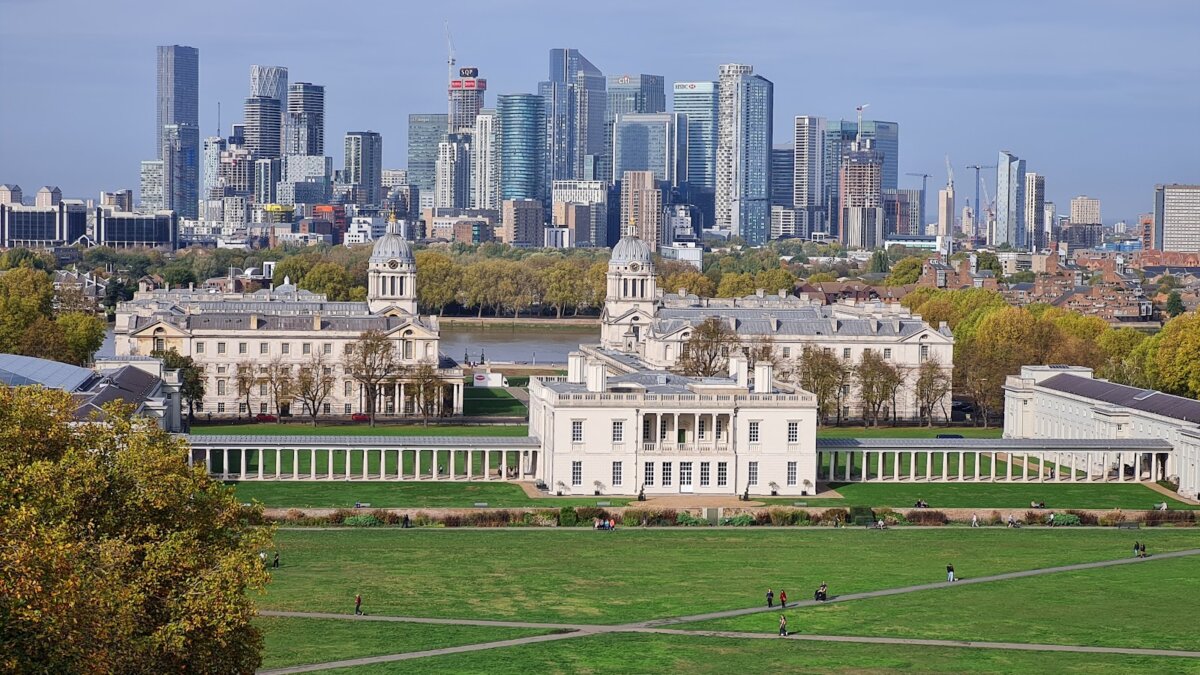
The Old Royal Naval College holds the Guinness World Record as the most filmed heritage location in the United Kingdom. Over the past century it has appeared in more than three hundred productions. Christopher Wren designed it in the 1690s and it looks, from almost every angle, like something a production designer would invent if given an unlimited budget and told to create a building that could plausibly stand anywhere in Europe at any point in history from the seventeenth century to the present day.
The chapel of St Peter and St Paul was where the second wedding in Four Weddings and a Funeral took place, with the nervous Father Gerald fumbling through the service. The Grand Square became revolutionary Paris for the Les Misérables film adaptation, with a seven-metre polystyrene elephant built to represent the Elephant of the Bastille. The colonnades were dressed as Florence for the closing café scene in The Dark Knight Rises. The same colonnades became Regency London for Bridgerton, and revolutionary Paris again for Napoleon.
It is open to the public and free to enter. The Painted Hall inside, which has been called Britain’s Sistine Chapel, is one of the most astonishing interiors in London and is worth the journey to Greenwich on its own. Once you have been inside it, you will immediately recognise it every time it appears on screen, which is often.
York Rise and Laurier Road
As seen in: Fleabag (2016 to 2019)
Phoebe Waller-Bridge made Fleabag in the neighbourhood where she actually lived. The location manager Ian Hutchinson described the brief in the first creative meeting as wanting Fleabag’s family to live near each other, in a community, all within walking distance. Dartmouth Park, in the hilly streets between Kentish Town and Highgate, was chosen because it felt like an actual north London life rather than a produced version of one.
The café where Fleabag runs her guinea pig themed business was the Village Café on York Rise, now a Turkish restaurant called Bold Café. The exterior of her sister Claire’s house is on Laurier Road, two minutes’ walk away. The church scenes in the second series were filmed at St Andrew’s in Kingsbury. The infamous sexhibition in the first series was shot at Tate Modern.
The streets in Dartmouth Park are entirely unassuming in person, which is precisely the point. What Waller-Bridge understood is that the comedy of embarrassment and the comedy of tragedy both require a believable backdrop, and leafy north London streets with small shops and buses and people not looking at each other on the pavement are as close to the texture of actual London life as any drama has ever managed. Walk the area on a weekday afternoon. It is extremely quiet and extremely recognisable.
280 Westbourne Park Road
As seen in: Notting Hill (1999)
The blue door at 280 Westbourne Park Road is the most photographed front door in London. In Notting Hill it was the entrance to the flat of William Thacker, the bumbling bookseller played by Hugh Grant. In real life it was the home of the film’s screenwriter Richard Curtis, who sold it shortly after filming for what was reported at the time as £1.3 million, making it possibly the most profitable piece of estate agency ever conducted through incidental product placement.
The famous blue door was removed after filming and auctioned for charity. A black door replaced it. Then, some years later, the house was repainted blue again, because the current owners apparently accepted the inevitable. People still make the journey to photograph it every day. There is something genuinely London about this: a residential street in west London where someone just lives, which has become a pilgrimage site for people from all over the world because a very good romantic comedy was filmed there twenty-five years ago.
The bookshop at 142 Portobello Road that William runs in the film was not a bookshop at the time of filming. It was Nicholls Antique Arcade. It is now a gift shop that has leaned into its association with the film rather than fighting it. The real travel bookshop that inspired William’s business was around the corner on Blenheim Crescent, but it closed in 2011. Walk the whole stretch of Portobello Road before and after visiting the door. The neighbourhood makes more sense as a totality than as a pilgrimage to a single painted door.
The Painted Hall
As seen in: The Golden Compass (2007) · Napoleon (2023) · Bridgerton (2020 onwards)
The Painted Hall is sometimes called Britain’s Sistine Chapel, which is a comparison that does not quite land until you are standing in it. Sir James Thornhill spent nineteen years painting it between 1707 and 1726. The ceiling and walls cover roughly forty thousand square feet. The detail is extraordinary and the sense of scale is overwhelming. It is also completely free to visit, which seems like an administrative oversight that has never been corrected.
Nicole Kidman’s Marisa Coulter first appears in this room in The Golden Compass, presiding over an elegant dinner party at what is presented as Jordan College in Oxford. Joaquin Phoenix as Napoleon delivers military commands from these walls. Bridgerton uses it repeatedly for scenes where the ton assemble and manoeuvre around each other. The production designers for all of these films chose the Painted Hall because it represents a concentration of Baroque grandeur that would cost tens of millions to replicate and is available in Greenwich for free on a Tuesday afternoon.
It is part of the Old Royal Naval College site. Go on a weekday morning when the tour groups are thin. Stand in the middle of the floor and look up for a minimum of five minutes. This is the correct amount of time to actually see what Thornhill did rather than photograph it and leave.