
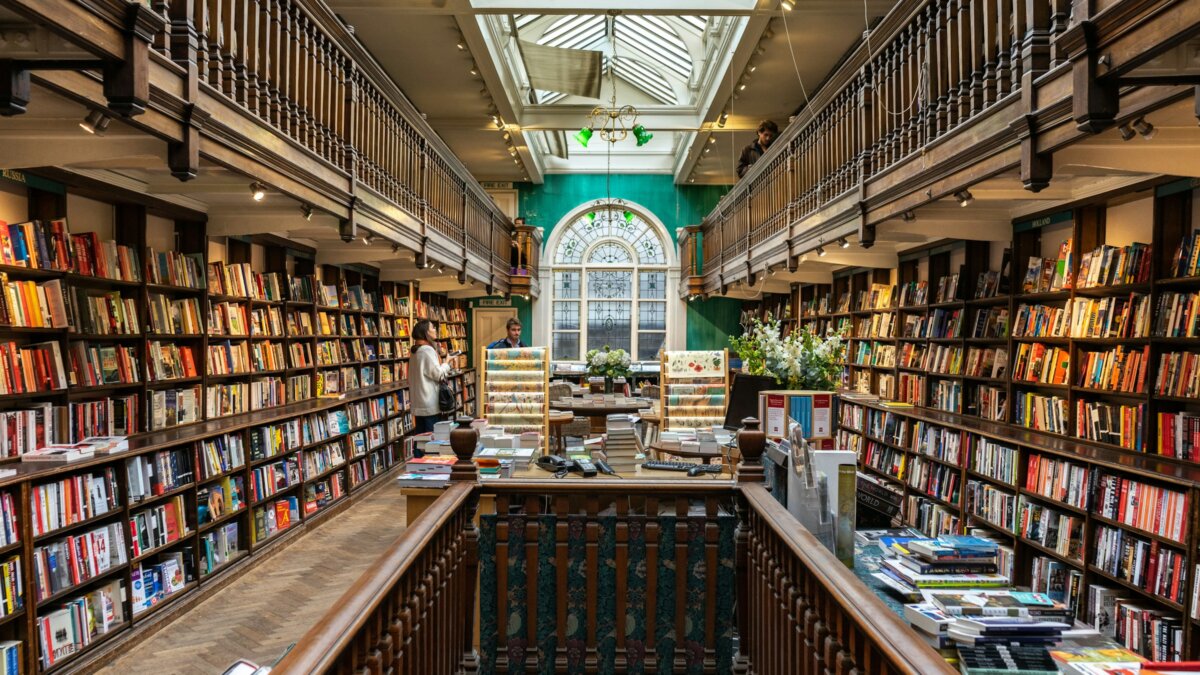
Anderson has never actually shot a feature in London, yet the city is full of places that feel like he designed them. Here are ten spots that could pass for a film set.
The Georgian obsession with symmetry. The Victorian love of colour coded everything. The institutional palette of duck egg blue and sage and cream. London did not mean to be a Wes Anderson set. It just happened.
Every great Anderson film works because someone cared enormously about every single thing in the frame. The fonts, the fabrics, the precise angle of a hat brim. What you find when you start looking for that quality in London is that the city has been producing it for centuries, in buildings and interiors and streets that were made by people with an equally specific vision. These are ten of the best.
Daunt Books
Stand at one end of the main room and look down the length of it. Oak balconies on both sides, skylights running along the ceiling, books arranged by country rather than genre so that fiction and travel writing sit side by side. The perspective is so precisely composed it looks like it was designed for a camera. It was not, obviously. It is just a very good Edwardian bookshop that has had the good sense to stay exactly as it was.
Go on a weekday morning if you can. The light comes in softly and the room is quiet enough that you can actually hear the creak of the wooden floor. Take the narrow stairs up to the gallery level and look back down. That is your shot.
Sketch
The all pink Gallery Room at Sketch is the most overtly Anderson interior in London. Curved walls upholstered in rose, chairs that match the walls, walls that match the ceiling. Every surface coordinated in the same dusty blush. David Shrigley illustrations peer from the walls. The egg shaped bathroom pods in the basement are their own separate achievement and should not be missed.
Book afternoon tea. It is expensive and the food is less interesting than the room, but that is fine because you are not really here for the food. You are here because the room looks like a still from The Grand Budapest Hotel that someone turned into an actual building and put in Mayfair.
Leighton House
Victorian painter Frederic Leighton built himself a house in Holland Park with an Arab Hall at its centre. The hall is covered floor to ceiling in Islamic tiles sourced from across the Middle East, with a small fountain at its heart and gilded mosaics around the dome overhead. It is utterly obsessive and utterly specific, which is exactly the energy.
The rest of the house is just as considered: the silk hung Narcissus Hall, the high studios built to catch the north light, the garden just visible through the tall windows. Leighton was a man with an extremely clear idea of what he wanted everything to look like. He would have understood Anderson completely.
Dennis Severs’ House
An American artist named Dennis Severs bought a Georgian townhouse on Folgate Street in the 1970s and spent the rest of his life staging it as if a Huguenot family still lived there. Candles burning. Half eaten food on the table. Coats on the hooks. The fire still warm. He called it a still life drama and the description holds up.
The house is open on Fridays, Saturdays and Sunday afternoons. The candlelit evening tour on Mondays is a different level entirely and worth planning your visit around. No photographs allowed inside, which is annoying and also exactly right. Some things should just be experienced.
Fortnum and Mason
The eau de nil green facade on Piccadilly is one of the most specific colours in London. Not mint. Not sage. Not seafoam. A particular shade that Fortnum and Mason has been using for over a century and that is somehow both sober and completely distinctive. The clock above the entrance has little figures that emerge on the hour. The double helix staircase inside spirals up through floors of very specifically packaged things.
You do not have to buy anything. Just walk through it. The hampers alone, wrapped in their particular shade of green and tied with ribbon, look like props from a film where everyone is impeccably sad in very beautiful clothes.
Bute Street
A single block of pastel shopfronts in South Kensington that looks almost too coordinated to be accidental. Pale yellow next to powder blue next to blush pink, each one a slightly different shade, all of them somehow working together. It is one of the most photographed streets in London for exactly this reason and it still manages to look good in photographs, which is harder than it sounds.
Walk it in flat morning light. The colours are at their best before the sun gets too high and too harsh. If you can catch it on a quiet weekday morning before the neighbourhood properly wakes up, it is genuinely lovely.
Burlington Arcade
A Regency era covered arcade with uniformed Beadles who patrol it enforcing a code of conduct that dates back to 1819. No singing. No running. No opening umbrellas. No whistling. The Beadles have the quiet, unflappable authority of a Wes Anderson supporting character who has been doing exactly this job for a very long time and intends to continue doing it.
The arcade itself is a perspective shot: arched shopfronts receding symmetrically into the distance, the glass ceiling letting in pale London light, the whole thing feeling like a corridor in a very elegant institution. Walk through it slowly. Do not whistle.
Arnos Grove Tube Station
In the early 1930s, London Underground commissioned an architect named Charles Holden to design a series of stations for the extended Piccadilly line. What he produced were some of the most quietly extraordinary buildings in London, and Arnos Grove is the best of them: a perfect cylindrical brick drum with a flat concrete canopy, sitting in a residential street in Zone 4 like a building from a slightly different, better designed version of the city.
The whole Holden trail is worth half a day if you are the sort of person who travels on public transport primarily to look at the stations. Sudbury Town, Southgate and Oakwood are all worth seeing. But Arnos Grove is the one you will actually remember.