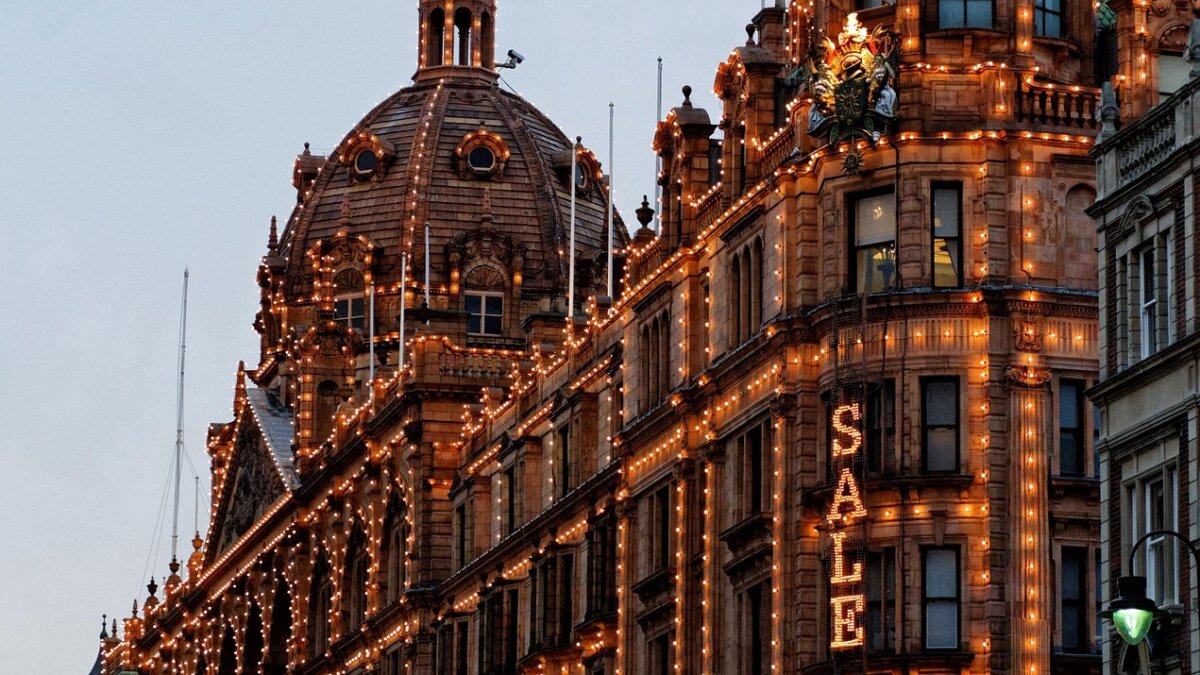
There are institutions in this city so enormous, so embedded in the London psyche, that we stop seeing them properly. Harrods is one of those. Fifteen million people a year pour through its bronze-handled doors, most of them staring up at the terracotta facade and thinking: beautiful. Expensive. Famous. What they don't think, what almost nobody thinks, is: what on earth is actually going on inside that building?
Sit down. We've been doing some digging.
It all started with a tea chest and a delivery boy.
Before Harrods was draped in gold and guarded by doormen in top hats, it was a single room off the Brompton Road, run by a 25-year-old grocer named Charles Henry Harrod who had previously traded from Borough and Clerkenwell. He arrived in Knightsbridge in 1849 with a keen eye on the Great Exhibition of 1851 nearby in Hyde Park, figuring, quite rightly, that a river of wealthy visitors would need somewhere to spend their money. His staff numbered four. His stock was mostly tea.
Within thirty years, he had one of the most talked-about department stores in London. Not bad for a man who started with a single room, two shop assistants, and a messenger boy.
The night the whole thing burned to the ground
On the 7th of December 1883, just before one in the morning, Harrods caught fire. All four floors were gone. The kind of catastrophe that would have finished most businesses before breakfast. Charles Harrod was not most businessmen.
Not only did he rebuild on the same spot, he also fulfilled every single Christmas order that year, every last one, and still managed to turn a record profit. The loyalty of his customers and the sheer tenacity of the man became London legend. The building you walk past today, all cherubs, terracotta and Art Nouveau grandeur, rose from those ashes, designed by architect Charles William Stephens and completed in 1905.
England's first escalator and the brandy that came with it
On a Wednesday morning in November 1898, Londoners stepping into Harrods encountered something they had never seen in their lives: a moving staircase. It was made of a leather belt, wound around a mahogany and glass frame, and it went up. That was, apparently, enough to cause widespread panic.
Management, to their eternal credit, anticipated this. A liveried attendant waited at the top of each escalator armed with either a generous measure of brandy or a vial of smelling salts, depending on the constitution of whoever stumbled off. Whether customers preferred the brandy or the salts, history does not record. We know which we'd choose.
Did you know? Harrods has its own water supply
Here's one that almost nobody knows. Somewhere deep in the building's basement, beneath the Food Halls, beneath the Egyptian Escalator, beneath five acres of marble and mahogany, sits a private water supply. Three boreholes, drilled in the early 1900s, reach 150 metres below Brompton Road and pump up to 1,090 cubic metres of water a day. The store is, in the most literal sense, a city within a city.
There's also said to be a secret tunnel, or rather, there used to be. A passage once ran beneath the road, connecting a warehouse at Trevor Place to the main store, used to move stock out of sight of the street. It was filled in when the surrounding area was redeveloped in 2002. Whether any other tunnels exist is, naturally, not something Harrods tends to discuss.
The secret penthouse, the helipad, and the VIP entrance
Former staff have let slip over the years that the building holds rather more than its 330 public departments suggest. There is said to be a private penthouse, discreet and entirely unmarked, where certain clients can view and try pieces in complete seclusion, away from the sales floor and very much away from other shoppers. Among those who have reportedly made use of it: Beyoncé and Drake.
On the roof, a helipad. And somewhere within the building, an access route used exclusively by royals and celebrities to enter and exit without setting foot on a public pavement. According to one former employee, fewer than five members of staff know precisely where it is.
The policy around very large cash payments is also quietly remarkable. If a customer attempts to pay more than £2,000 in notes, the cashier may apologetically inform them that the till is temporarily out of order. This is not true. It is a signal. Security will be with you shortly.
You could buy a lion, an alligator, or an elephant, no questions asked
The Harrods Pet Department opened in 1917. For a while it sold the usual: puppies, canaries, the odd rabbit. Then it didn't. By the time it hit its stride, you could walk in off the Brompton Road and walk out with a panther.
Noël Coward, the playwright and wit, bought himself an alligator for Christmas. Ronald Reagan, then Governor of California, acquired a baby elephant named Gertie in 1967, reportedly as a gift that nodded to the Republican party's pachyderm emblem. Christian the Lion, whose reunion with his owners became one of the most watched clips in early internet history, began his life in the Harrods pet department in 1969.
The department closed in 2014. The cobra, however, came later: in 2007, a pair of sandals set with rubies and diamonds, priced at £62,000, was placed on display in the shoe department and guarded by a live snake. Security, Harrods style.
Winnie the Pooh was born on the shop floor
In 1921, a writer named A.A. Milne walked into Harrods and bought a teddy bear for his young son, Christopher Robin. That bear, scruffy, yellow and endlessly patient, became the model for one of the most beloved characters in English literature.
It doesn't stop there. After Beatrix Potter published The Tale of Peter Rabbit in 1902, Harrods began selling a licensed soft toy of the rabbit, widely believed to be the first commercially licensed fictional character in history. Two of the great cornerstones of British children's fiction, both born on the Harrods shop floor.
Harrods once arranged your funeral
The store's Latin motto, Omnia Omnibus Ubique, meaning all things for all people, everywhere, was not hyperbole. For much of the twentieth century, Harrods offered a fully managed funeral and embalming service.
Among those who made their final arrangements through the store: Sigmund Freud, who died in London in 1939 having fled Vienna after the Nazi annexation of Austria, and Clement Attlee, the post-war Prime Minister, in 1967. Whether either man knew they were going out on a Harrods account is, perhaps, beside the point.
The service also sold aeroplanes from 1919. You can still charter flights through Harrods Aviation. And in 2000 the store briefly launched an online casino. Shop until you literally cannot stop.
The New Zealand town that declared war and won
In 1986, Mohamed Al Fayed, who had bought Harrods the previous year, instructed his lawyers to go after a restaurant owner in a small New Zealand town called Otorohanga, who had named his establishment Harrods. Standard enough legal territory.
What happened next was not standard. In solidarity, every single business in the town changed its name to Harrods. The local council temporarily renamed the town itself Harrordsville. The story went around the world. Al Fayed, faced with the most expensive possible publicity disaster, dropped the case entirely. Otorohanga, or Harrordsville, had won.
12,000 lightbulbs and 300 need changing every single day
The famous illuminated exterior, that warm golden outline that makes Knightsbridge glow on dark November evenings, runs on somewhere between 11,000 and 12,000 individual bulbs. Around 300 burn out and are replaced every single day. It is, in other words, a full-time job just keeping the building lit.
The lights were switched off on the night that Dodi Fayed and Diana, Princess of Wales, died in Paris in 1997. Al Fayed, who owned the store, later placed two memorials inside: one with photographs and personal effects from Diana's last evening, and a bronze statue unveiled in 2005 of the pair dancing on a beach, the work of sculptor William Mitchell.
Harrods began as one man, one room, and a delivery boy. It has survived fire, IRA bombs, legal battles across three continents, and the invention of the escalator. It has its own water supply, its own bank, its own helipad, and in all likelihood its own secrets that no former member of staff has yet spilled. Which is exactly why we'll keep asking.
Harrods
87 to 135 Brompton Road, Knightsbridge, SW1X 7XL
Nearest Tube: Knightsbridge (Piccadilly line), use the Brompton Road exit