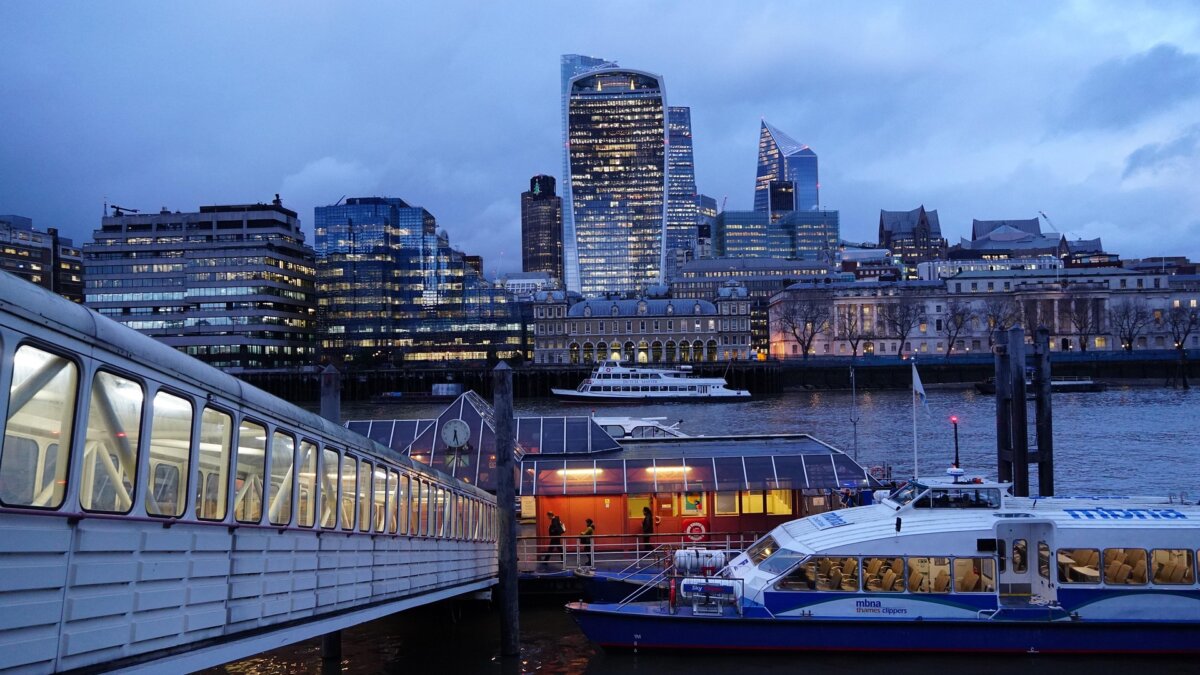
London has, over the course of its long and restless life, been crossed by every conceivable means: on foot, on horseback, by sedan chair, by omnibus, by Underground, by bicycle and by black cab. But tucked alongside the familiar routes are a handful of others that most Londoners have never taken — some ancient, some startlingly modern, all of them offering a genuinely different view of the city. Here are five ways of moving through London that are worth seeking out.
The Thames Clipper to Greenwich
The Thames has always been London’s original highway. For most of the city’s history it was far faster to travel by river than to fight through the chaos of the streets, and the river teemed with watermen, ferries, and barges carrying everything from coal to kings. That tradition survives today in the form of the Thames Clipper river bus service, whose sleek commuter catamarans run regularly between central London and Greenwich, stopping at piers that read like a map of the city’s history: Blackfriars, Bankside, London Bridge, Bermondsey, Canary Wharf.
The journey to Greenwich takes around forty-five minutes from Embankment, and it remains one of the finest ways to approach what is arguably London’s most historically loaded destination. As the boat rounds the great bend in the river, the old Royal Naval College — designed by Wren, painted by Thornhill — opens up ahead of you exactly as it was meant to be seen: from the water. The Cutty Sark sits dry-docked just beyond. Brunel’s tunnel mouth is buried somewhere beneath your feet. The view has barely changed in two hundred years, and it still lands.
Oyster cards are accepted, and the Clipper runs frequently enough to use as a genuine commute. But it also works wonderfully as a slow, unhurried way to arrive somewhere.
The Hampton Court Boat
Less known and considerably more leisurely is the boat service that runs between Richmond and Hampton Court, following the Thames upstream through one of its most quietly beautiful stretches. This is the river at its most rural — willows trailing in the current, herons motionless on the banks, the occasional lock keeper’s cottage sitting as it might have done in a Victorian watercolour.
Hampton Court Palace itself has stood on this bend of the river since the early sixteenth century, when Cardinal Wolsey built it to impress a king and then, famously, handed it over when the king in question grew too interested. Henry VIII expanded it enormously, and the Tudor kitchens and great hall survive largely intact. Generations of monarchs arrived here by royal barge, and there is something quietly satisfying about approaching it the same way — by water, at a pace that allows the full length of the gardens to unfold before you.
The boat journey takes around three hours from Westminster Pier depending on season and tide, and runs from spring through to autumn. Worth every minute of it.
The Regent’s Canal Narrowboat
Cut between 1812 and 1820 as part of the Grand Union Canal network, the Regent’s Canal threads eight miles through the heart of north London, connecting Paddington Basin in the west to Limehouse Basin in the east, passing through Little Venice, Camden, Islington, and Hackney along the way. For much of the nineteenth century it was an industrial artery, carrying timber, coal, and building materials; the narrowboats that worked it were home to entire families, who lived a parallel London existence almost entirely invisible to the streets above.
Today, the canal is one of the city’s most interesting routes on foot or by bicycle — but you can also travel it as it was always intended, by water. Several operators offer passenger narrowboat trips along different sections, with the stretch between Little Venice and Camden being the most popular and the most beautiful. The passage takes you through Maida Hill Tunnel (where the boatmen of old would lie on their backs and walk the boats through with their feet against the tunnel roof, while their horses were led over the hill above), past London Zoo where you can occasionally spot giraffes peering over the fence, and into the noise and colour of Camden Lock.
It is an oddly peaceful way to travel through one of the world’s busiest cities, moving at four miles an hour through the back gardens and towpaths of a London that most visitors never see.
The IFS Cloud Cable Car
In 2012, with a confidence that some found baffling and others found admirable, Transport for London opened a cable car across the Thames between the Greenwich Peninsula and Royal Docks. It was the first urban cable car in Britain, built just in time for the Olympics and the kind of infrastructure decision that raises eyebrows even as it quietly becomes beloved.
The IFS Cloud Cable Car — it has had several names since opening, each corresponding to a new sponsorship deal — carries passengers 300 feet above the river in gondolas that offer a panorama of east London quite unlike anything available from the ground: the O2 Arena directly below, Canary Wharf gleaming to the west, the Thames winding out towards Tilbury. On a clear day the view extends from the City to the Essex marshes.
It is not, truthfully, a very practical way of getting anywhere — the two terminals are not naturally connected to anywhere most people need to go — but as an experience it is worth the trip entirely on its own terms. There is something quietly surreal about crossing the Thames not by bridge, not by tunnel, not by boat, but suspended silently in the air above it.
The Brunel Tunnel Under the Thames
And then there is the oldest of all these crossings — the one that made everything else possible.
In 1843, after eighteen years of engineering disaster, financial ruin, flooding, and a great deal of human suffering, Marc Isambard Brunel and his son Isambard Kingdom Brunel completed the Thames Tunnel between Rotherhithe and Wapping. It was the first tunnel ever dug successfully beneath a navigable river anywhere in the world. Nothing like it had ever been built. Engineers had called it impossible. Brunel built it anyway, using a tunnelling shield of his own invention that allowed workers to excavate the face of the Thames riverbed a few inches at a time while the completed tunnel was bricked up behind them.
It opened as a pedestrian tunnel and was for a time one of the great tourist attractions of Victorian London, with stalls and entertainers filling its arched chambers. It was later acquired by the railway and became part of the London Overground, where it remains to this day. You pass through it on the Overground between Wapping and Rotherhithe, usually in about thirty seconds, usually without knowing anything remarkable is happening.
The Brunel Museum at Rotherhithe tells the full story, including the extraordinary Engine House that was sunk into the ground to pump out the constant flooding. It is a small museum with an enormous story, and the tunnel itself — lit, arched, carrying trains through the riverbed — is still one of the more astonishing things in London, once you know to look for it.